
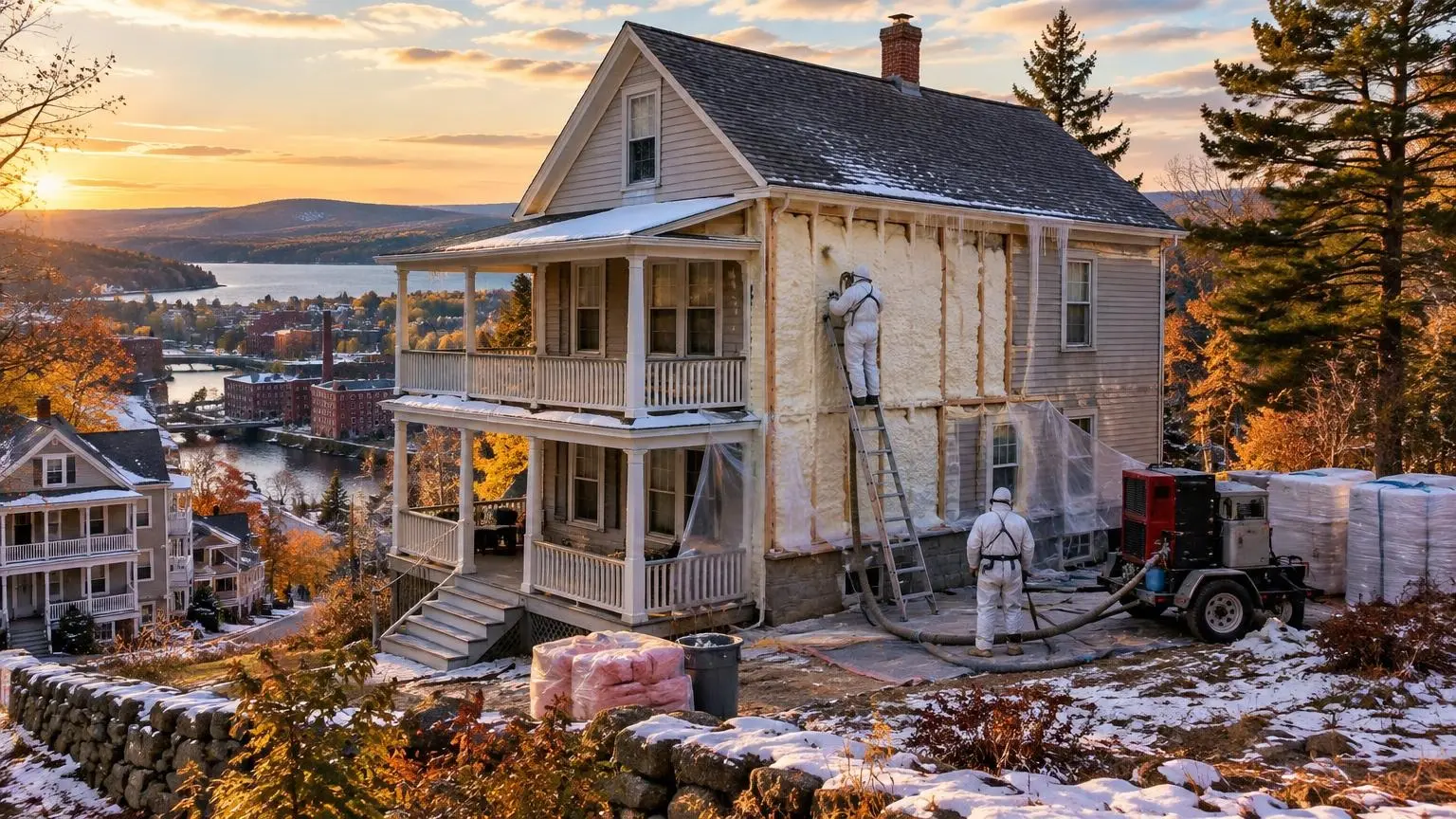
Insulation for Worcester's hills, three-deckers and suburbs
Spray Foam Insulation in Worcester, MA
Air sealing and insulation for older city homes and newer suburban houses across Worcester County.
- Free on-site estimates in Worcester County
- Written quotes that name the material, thickness and R-value for each area
- Wiring, moisture and vermiculite concerns pointed out before anything is covered
Keeping Heat in a Snowy Hill City
Spray foam insulation in Worcester has to stand up to a real New England winter. Wikipedia's climate summary for the city lists an average of 64 inches of snow a season, far more than the coast less than 40 miles away, and snow usually falls from late November into early April. January averages 24.1F around the clock, and the record low is -24F from February 1943. A house that leaks air at the attic and the foundation pays for it every day of that season. We seal those leaks and insulate the spaces that need it, using closed-cell or open-cell foam where foam is the right tool and blown-in insulation where it does the job for less.
Worcester's housing, and where it leaks
Wikipedia notes that the three-decker originated in Worcester, with the first ones built by Francis Gallagher, and that immigrants moved into new three-deckers lining hundreds of the city's streets as industry grew in the 19th century. Those buildings, along with Victorian singles and older colonials, were framed with open stud bays that let air travel from the basement to the attic. Porches, bay windows and flat or low-slope roofs add more paths. In the newer parts of the city and in the suburbs, ranches, Capes and colonials leak at the attic hatch, top plates, recessed lights, kneewalls and the rim joist.
Each type gets a different plan. A three-decker may need dense-pack in the outside walls and foam at the roof or top-floor ceiling. A Cape usually needs its kneewalls and the short attic floors behind them sealed. A 1990s colonial may only need its rim joist foamed and its attic topped up.
What the code asks for here
Massachusetts sits in Climate Zone 5A, as the state's stretch energy code states outright. The Insulation Institute's summary of the 2021 IECC-based stretch code, in effect from January 1, 2023, lists R-60 for ceilings, R-30 (or R-20 plus R-5 continuous, among other options) for wood-frame walls, and R-19 or R-15 continuous for basement walls in Zone 5. Those numbers apply to new work and additions. For an existing house, they make a useful yardstick: most older Worcester attics we see are far below R-60.
Closed cell vs open cell
Open-cell foam is soft and light. It expands to fill a cavity and stops air, while letting some water vapor pass. HomeGuide lists it at R-3.5 to R-3.7 per inch. Closed-cell foam is dense, at R-5 to R-7 per inch, and at normal thickness it acts as a vapor retarder and shrugs off water. In Worcester that makes closed-cell the usual pick for rim joists, fieldstone or poured basement walls, garage ceilings under living space and roof decks with no room for vent channels. Open-cell works well in interior cavities and some roof assemblies where the vapor side is handled separately.
Foam is not always the answer. On an open attic floor, it usually costs less to seal the leaks with foam and caulk and then blow cellulose or fiberglass to depth. We say so when that is the better plan, and the quote can show both options.
What to ask spray foam insulation contractors
When you call insulation contractors or spray foam insulation companies around Worcester, a few questions separate careful crews from rushed ones. Ask what gets sealed before anything is insulated. Ask which foam goes where and why, and what thickness and R-value are written on the quote. Ask how they deal with knob-and-tube wiring, vermiculite and old wet insulation. Boston's city guidance on insulation barriers notes that knob-and-tube was common in homes until the 1940s and that an inactive system does not stop insulation work, so an honest contractor checks before quoting. Ask how long you need to stay out after spraying; HomeGuide's guidance is at least 24 hours.
Spray foam insulation cost
HomeGuide's 2026 guide puts installed spray foam at $1.50 to $5.00 per square foot, with open-cell at $1.50 to $3.50 and closed-cell at $3.00 to $5.00. It lists rim joists at $2,000 to $2,500 and whole-house jobs at $8,000 to $20,000, and notes that many installers have a minimum of $1,000 to $2,000 or more. Fixr lists foam in existing walls at $3.15 to $7.50 per square foot. These are national numbers for budgeting. In Worcester, access is often the biggest local cost driver: tight attics in three-deckers, finished kneewalls and steep stairs add labor. Your written estimate is the number you pay.
Mass Save and timing
Mass Save lists no-cost Home Energy Assessments for people living in one- to four-unit homes, and 75 to 100 percent off approved insulation improvements, with up to no cost for income-qualified households. If you want those incentives, start with the assessment. Basements can be sprayed in any month, but attics and unheated spaces are easier outside the coldest weeks, since foam needs the surface and the material within a working temperature range. Fall books up fast as people try to get ahead of the first snow.
Why Homeowners Call Spray Foam Insulation Worcester
We see it before we price it
Quotes follow an on-site look at the attic, basement and walls, not a phone guess.
Air sealing comes first
Top plates, chases, penetrations and the rim joist get sealed before new insulation hides them.
Material chosen per area
Closed-cell, open-cell, dense-pack or loose fill, with the reason for each written on the quote.
Barriers named up front
Live knob-and-tube, vermiculite, leaks or damp framing are pointed out before any work is scheduled.

Common Questions
Can spray foam get a higher R-value than other insulation?
Per inch, closed-cell foam is near the top: HomeGuide lists R-5 to R-7 per inch, against R-3.5 to R-3.7 for open-cell. That matters in tight spaces like rafters, rim joists and three-decker walls where there is no room for thick batts. In an open attic, depth is cheap, so loose fill can reach R-60 for less.
Does spray foam insulation stop mold?
Foam does not kill mold, but it can stop the warm, damp indoor air that condenses on cold surfaces and feeds it. Closed-cell foam on a rim joist or basement wall keeps that air off cold wood and concrete. If there is an active leak or wet framing, that has to be fixed first, and we point it out before quoting.
What's the average cost per square foot for spray foam insulation?
HomeGuide's 2026 range is $1.50 to $5.00 per square foot installed: $1.50 to $3.50 for open-cell and $3.00 to $5.00 for closed-cell. Fixr lists $3.15 to $7.50 for existing walls. Your written estimate after a visit is the actual price.
What R-value does Massachusetts require in an attic?
The stretch code summary from the Insulation Institute lists R-60 for ceilings in Climate Zone 5, which covers all of Massachusetts. That applies to new work. For an existing home it is a good target, and many older Worcester attics are well below it.
Can I use Mass Save with spray foam?
Mass Save lists 75 to 100 percent off approved insulation improvements after its no-cost Home Energy Assessment. The incentive applies to work approved through that program, so book the assessment first if you want it. For work outside the program, such as a garage ceiling or a shop, we price it directly.
Is spray foam safe in a house with old wiring?
Knob-and-tube wiring was common until the 1940s, and city guidance from Boston says an inactive system does not stop insulation. A live system is different and needs an electrician before anything covers it. We check during the visit and tell you what we find.
Insulation Services
Six services, matched to the house in front of us: foam where it earns its cost, loose fill where it does the job for less.
Spray Foam Insulation
Closed-cell and open-cell foam for rim joists, rooflines, walls and garages, chosen for each surface.
Learn more →Attic Air Sealing & Insulation
Seal the leaks at the attic floor, then bring the insulation up toward R-60.
Learn more →Wall Insulation
Dense-pack and injection insulation for older walls, foam for walls that are open.
Learn more →Basement & Rim Joist Insulation
Closed-cell foam on rim joists and foundation walls to stop cold drafts at the base of the house.
Learn more →Garage & Bonus Room Insulation
Foam in garage ceilings, bonus room floors and kneewalls so rooms over garages stay comfortable.
Learn more →Insulation Removal & Replacement
Out with wet, dirty or rodent-damaged insulation, then sealing and new insulation in its place.
Learn more →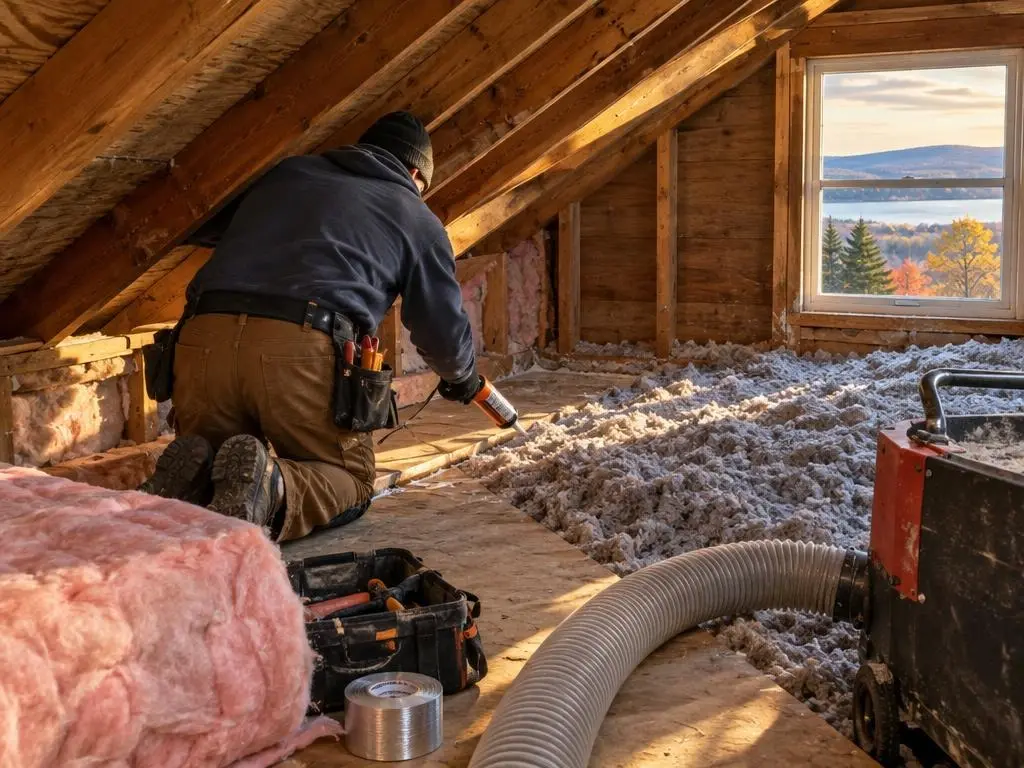
Towns We Serve
We work in Worcester and in the towns around it: Shrewsbury, Northborough, Westborough and Grafton to the east; Auburn, Millbury, Sutton and Oxford to the south; Spencer to the west; and Holden, Paxton, West Boylston and Boylston to the north around the Wachusett Reservoir. The hill towns to the north and west sit hundreds of feet higher than the Blackstone Valley towns, and the mill villages hold older houses than the newer subdivisions east of the city. Each town page covers what is different there.
- Spray Foam Insulation in Worcester, MA
- Spray Foam Insulation in Shrewsbury, MA
- Spray Foam Insulation in Auburn, MA
- Spray Foam Insulation in Millbury, MA
- Spray Foam Insulation in Grafton, MA
- Spray Foam Insulation in Holden, MA
- Spray Foam Insulation in West Boylston, MA
- Spray Foam Insulation in Boylston, MA
- Spray Foam Insulation in Northborough, MA
- Spray Foam Insulation in Westborough, MA
- Spray Foam Insulation in Paxton, MA
- Spray Foam Insulation in Spencer, MA
- Spray Foam Insulation in Sutton, MA
- Spray Foam Insulation in Oxford, MA
Get a Spray Foam Insulation Estimate in Worcester
Book a free visit and get a written, area-by-area quote.